
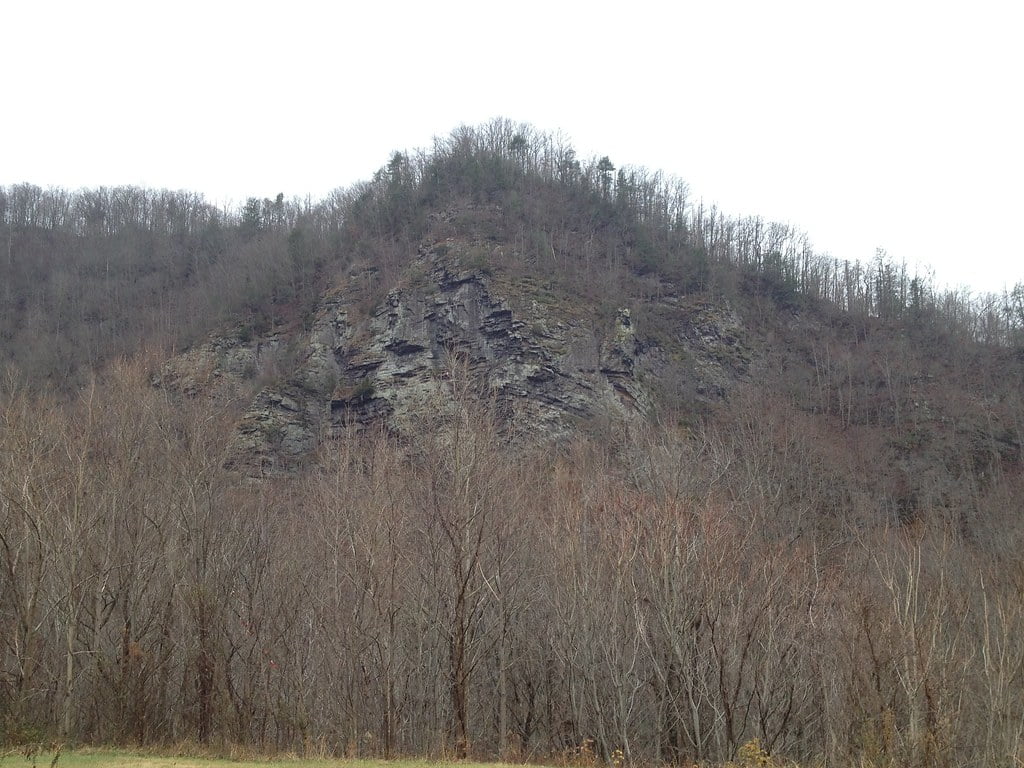
Mountain lore abounds in the hills and valleys of Northeast Tennessee. Tales passed down from the Cherokee Indian tribes are rich with spirits and strange occurrences. Anyone who grew up around the Lamar School community, State Highway 107 toward Greeneville and State Highway 81 South toward Erwin was told many tales about the Devil’s Looking Glass.
This jagged, vertical rock face stands above a bend in the Nolichucky River in Unicoi County, just alongside Highway 81 South. For those interested in an exact location, you can find it at Latitude: 36.1414967°N, Longitude: -82.4437511°W, with an approximate elevation of 2,218 ft. The actual formation is about 800 feet above the river itself. The appearance is irregular and the rock formation faces the river and road, as if staring at travelers. Even as a child, I didn’t like traveling this road, especially at night.
Local Folklore
Popular folklore that is told and retold among local residents is filled with stories of people who were drowned near this area. The Nolichucky River, also called The Devil’s Run, is a 115-mile stretch of turbulent and dangerous water beginning in North Carolina and spilling out into the French Broad River in East Tennessee. It is filled with rocks, pools, eddies and strong currents that make it challenging to say the least.
One story passed down from my grandmother claims that the local Cherokee and Yuchi Indians called the Nolichucky “River of Death,” due to the many lives claimed by it. Known for sudden drop offs, dangerous currents and surprise flooding, the Indians traveled it with care and avoided camping too close to its banks.
Perhaps the most popular story is that of a sad Cherokee woman who flung herself from the top of the Devil’s Looking Glass. She had lost her lover in one of the Indian wars and, filled with anguish, chose to die rather than live without him. Legend tells that her pitiful wail echoed up and down the river valley as she fell. Local residents and not a few campers have told of hearing a long, wailing cry at night; some even say something can be heard crashing into the water just as the wail ends.
Why “The Devil’s Looking Glass?”
The rock formation locally known as The Devil’s Looking Glass claims its name from Cherokee Indians who could make out a terrible face when the moonlight shined on the rock face from a certain angle. Even in daylight, when the shadows fall just right, an evil face can be discerned. Some say more than one face can be seen. The Cherokee believed the rock face was a window into the netherworld, the abode of the devil, and they could see him looking out, as though he were looking at himself in a mirror; hence, “The Devil’s Looking Glass.”
Another popular story claims that a strange, deep cave is located about halfway up the rock face, but it is difficult to pick out from below because of the jagged face. Stories differ about what can be found in this cave, but most say a demon lives there, waiting to dive into the river below and capture unsuspecting canoe travelers. Indians were said to paddle quickly past this location while looking upward the entire time, so as to avoid the demon if possible.
Yet another story claims that Cherokee Indians would chase deer off the ledge of The Devil’s Looking Glass, then harvest the carcasses from below to feed their tribes. Such a horrific hunting tactic conjured up terrible spirits that supposedly haunted the cliffs to prevent this from happening anymore. Some travelers and sportsmen claim to see ghostly apparitions around the rock face or along the river below at night.
No information can be found about scaling The Devil’s Looking Glass, likely because it is too unstable and dangerous to attempt a climb. The surrounding land belongs to the U.S. Forestry Service and is nearly unpassable. Many river enthusiasts hike, fish and canoe along the Nolichucky River and pass underneath The Devil’s Looking Glass. More information on guided river rafting and fishing can be obtained from local guide services.
Do you have a first-hand story about The Devil’s Looking Glass? Share it or your other legends from Northeast Tennessee folklore with us in the comments section.